Who feeds me? An essay about nurturing others... while quietly falling apart

The holiday that's not a holiday
I have a big life event coming up, one I have been anxiously anticipating for the entire year so far. It will be my first time living it, and depending on how it goes, it could quite possibly be the last. I'm equal parts nervous and excited, quizzing myself, am I mad? and in the same breath self-reassuring with it's going to be fine, enjoyable even... at least sometimes, maybe?

The life event that's riddled me with angst and anxiety? Stepping away from work for August to spend with my two pre-schoolers. Yes, the entire month (teeth-gritted emoji). Some well-intentioned folk might respond with, what's wrong with that? It's a whole month off work, you'll enjoy it! Those commentators have probably forgotten what life with a three- and four-year-old is actually like. Or perhaps they were never the default parent to begin with.
Even my phrasing of the August situation isn't accurate and it's a linguistic trap that all of us mothers fall in to. While I'm stepping away from my paid job for a month, I will still very much still be working. You see, taking care of littles IS work.
I find it more challenging than my day job, just for the 'food-work' alone.
I'm not forced into this situation; but I desperately want to be a 'cool-mom', the type of mom who can take a month off work to be with my kids and not sweat it one bit. Be spontaneous, they say. Live in the moment.
Maybe it's mom guilt. I'm a freelance dietitian so I technically can reshuffle my caseload and move clients to the evenings after bedtime. If I can, I probably 'should' - and that's the first time a 'should' is introduced into this story.
I'm shining a light on the work involved with feeding our families. Not just 'cooking dinner' but all of the unseen mental and physical labour with planning, checking nutritional needs, the actual shopping, unloading, prepping, considering food waste, cooking, cleaning up and doing it, all, over, again. At three meals a day for 30 days .... 90 times in just one month, and that's without snacks or extras.

'Foodwork' is a concept introduced by America sociologist Marjorie DeVault. It means the tasks required to feed ourselves and our households, including preparation, shopping, cleaning up and washing dishes.
This UK based study from 2014-2015 found that women who did more foodwork spent less time on personal care, socialising and hobbies, which was not the case for men.
Less time on personal care, socialising and hobbies, great. So what's going on with us as we're so busy nurturing everyone else? We spend all day thinking about food and we are completely burnt out by it. Cutting fruit. Peeling cucumbers. Negotiating one more bite. Refilling water bottles. Washing lunchboxes. Planning tomorrow's meals.
And we get less time on personal care, socialising and hobbies to recuperate. It makes complete sense to me that when the house is quiet, the only thing that comforts us is food.
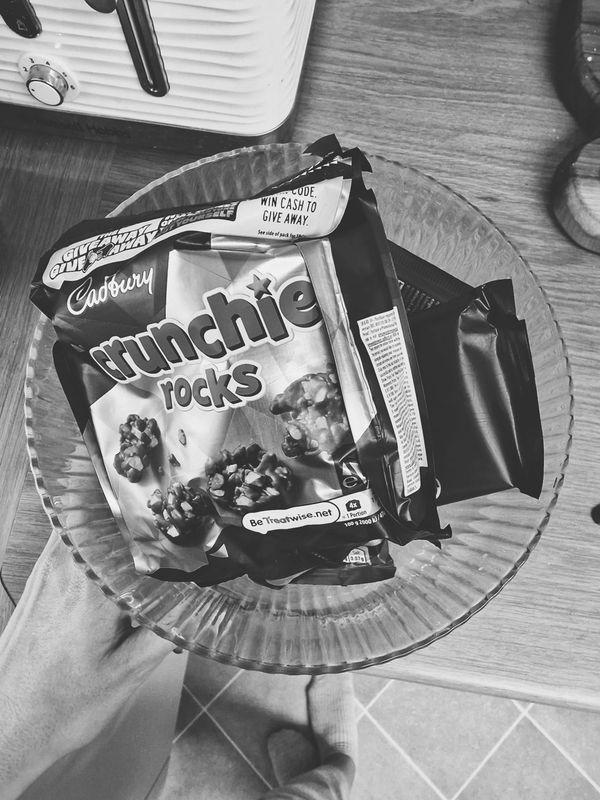
You bargain with yourself: I'll do a home-workout instead. I'll read. I'll have an early night. But eventually, like being on autopilot, you find yourself standing in front of the cupboard, phone in one hand, grabbing a mixture of fistfuls of granola, popcorn and the kids chocolate buttons with the other.
In a zombie like-doom scroll, you're fed an endless stream of perfect-mothers with perfect-bodies living their perfect-summers. You're fed perfection. Fed comparison. Fed the quiet belief that you should be coping better. After the binge, you are physically full, yet feel emptier than ever.
Fed by the guilt of every decision
We're fed some perfect, low-sugar, high-fibre, nutrient-dense recipe on Instagram. You know the hi guys, are you looking for a quick and easy meal with hidden veg that all my family devoured?
I roll my eyes and scroll past, those bloody meals are never quick and easy, its all for likes and shares. But subconsciously, their message seeps into my brain, and I can't help it. Joanne, you need other options than fish fingers. Joanne, green peas again? You need to get it together, you need to sort it out. More shoulds.
Listen to this essay on the Binge Eating Dietitian Podcast
Let's step inside the mind of a mother for a moment, on a typical day in school holidays. Before you've inhaled your first cup of coffee, your brain is already running through today's food logistics. Will she actually eat what I make, or will it end up in the bin? Because food that isn't eaten provides precisely zero nutrition.
Do we even have enough food in the house? I forgot to order the shopping. Maybe I can cobble something together from the freezer... except the freezer is tiny and we're renting, and everyone online seems to assume I have space for six weeks' worth of batch cooking.
Dinner needs to be quick. But not too quick, because quick usually means beige, and beige somehow feels like failure.
Tinned food feels like a failure. Baby pouches and microwaveable rice packets feel like a failure.
Better move the kettle from the counter, it's a hazard. The toddler is on the move, is the oven door locked?
By the time lunch is finally on the table, you've already made more decisions than most people in their 9-5 day job. And you'll have to do it all over again in just two hours, except now it's more of a struggle because you're exhausted. The day is starting to wear you down. I better down an extra coffee or a coke-zero, I'm gonna need the energy.
Then there's the financial cost. The food shop has gone up again. Can I justify buying fresh berries? Maybe I'll leave my own snacks this week. The children won't notice if I skip mine (this is reality - an Instagram follower shared it with me last week)
This inner-critic continues on repeat until my logical brain pipes up with eh, this isn't true or fair, you literally just made a Bolognese yesterday, and they all ate it. Don't let the perfect Insta folk get to you; give yourself a break. Fish fingers are fine.
For each one of these micro-decisions about food-work, there's a 'should' that's driving it. A societal expectation that as a mother, you 'should' be acting in a certain way.
You should be feeding your children in a certain way. Sophie morris says I shouldn't use baby porridge. The girls in the WhatsApp group were bitching about some influencer using pouches on holiday. You should be looking after yourself in a certain way. You haven't done much resistance exercise this week, you should do a home work-out after bedtime.
Somewhere along the way, food-work stopped feeling like work and started feeling like the minimum expected of mothers. That's why the guilt feels so personal. We assume the problem is us, not the impossible standard we've absorbed.

We assume binge eating is about willpower, hunger or control.
But after spending twelve hours managing food-work, maybe what you're craving is a release.
And then the moment arrives. The kids are finally asleep and there's just one hour of precious me-time. As soon as you quietly close that bedroom door and tip-toe onto the landing, you have a micro-second for a mammoth decision that doesn't happen consciously. Is it going to be a productive evening, or am I going to binge? It truly feels like it's one or the other, there's no space for anything in between.
Every evening feels like standing at a crossroads where one path leads to the version of yourself you promised you'd be this morning, and the other leads to the kitchen cupboard. Before you know it, you're so mentally exhausted that you don't even realise you're standing at the kitchen counter, shovelling in handfuls of granola again.
Like someone else might pour themselves a couple of glasses of ice-cold wine at the end of a long day, I reach for food. Ugh, why did I let that happen, I'll be good tomorrow. I'll get up before the kids to do that workout. Even though I'm absolutely exhausted. I need to get it together.
We carry the weight of food-work all day, the guilt of binge eating and now the guilt of 'wasting' an evening and not being productive. We blame ourselves, it's all my fault, I didn't need that twirl multipack, ugh.
It's not our fault.
This is why professionals need to be careful when understanding binge eating as an individual problem. Binge eating does not happen in isolation, it is intertwined with our culture and the 'shoulds'. Food-work and the mental load of parenting is an excellent example of that. At the end of a demanding day, food is comfort, it's a friend that doesn't ask us for anything. Food gives, and of course we take, because we haven't taken anything for ourselves all day.
'Good enough' genuinely is, good enough. For you. For the children.
Marjorie DeVault writes that foodwork is not simply about providing sustenance, but about "producing family life" as well. Another pressure for us mothers in one sense, but this reframe does help to view food-work as more than just the food itself. Because if family meals are reduced to their nutrition, we risk forgetting what meals are really for. Food nourishes bodies, but it also nurtures relationships, creates memories and communicates care.
So this August, I'm making a loud promise to myself instead of quietly falling apart. I invite you to do the same.
I will protect my sanity from the relentless food-work and the endless shoulds.
I will not allow food-work and the shoulds to rob me of this time with my family.
There will be Mcdonalds. There will be fish fingers. Toast will make a daily appearance.
I'm not pretending that letting go of perfection will magically stop binge eating. I will still be exhausted when bedtime comes. There will still be evenings when food feels like the only thing left that's mine.
But if I can carry just a little less guilt throughout the day, perhaps I'll need a little less comfort at night. And maybe that's what being the 'cool mom' I imagined actually looks like.

Read here about 1:1 Clarity Consultations with Me
Footnotes:
- I came across the concept of food-work by reading 'Can I have another Snack' substack by non-diet nutritionist Laura Thomas. You can subscribe to Laura's work here.
- I enjoy content by Paige Connell about motherhood, the mental load and the unfair division of labour.
- Find Marjorie DeVault's seminal work here: Feeding the Family. The Social Organisation of Caring as Gendered Work.